Should you do something about your phone addiction?
Actually, maybe not.

I have yet to read a person’s New Year’s resolutions that don’t include anything regarding phone usage. (I bet my sixteen-year-old brother doesn’t, but I also bet that my mom would be taking care of that.) There were posts making rounds on Substack: ‘Ten ways to use your phone less in 2026’, ‘How to stay offline more in 2026’. In my own 2026 goals, I included: ‘limit phone use to two hours per day.’
I first tried to vocalise the eternal internal conflict regarding social media and the online versus offline life a few years back. The piece was called Spaghetti, Cute Puppies or Why I Want to Quit Instagram, and it’s one of my favourites because on any given day, it still resonates.
Most of us are addicted to our phones. To throw a shiny stat in there, some 3.8 billion of us which makes around 48% of the world’s population (that’s not taking into account all those countries where people simply don’t have access to, or can’t afford phones). And, because it’s almost ‘everyone’, we’ve somewhat normalised it. We don’t seem to fret about it much. Despite this, sometimes when my phone addiction becomes obvious to me, when the biochemistry plays out in front of my eyes, it makes me terribly uncomfortable.
I am getting ready for bed on an idle Tuesday night, washing up after dinner and midway, right after I put the dishes in the rack to dry but before I wipe the countertop, I take off one rubber cleaning glove and tap on my phone with my pinky. Just to… you know, take a look. I see a reply to my last WhatsApp. Still with the sponge in one hand, I open it. And then my thumb does its reflexive, automatic, most natural of all motions and… opens Instagram. Suddenly, I am watching some guest of Steven Bartlett, talk about how we need to embrace problems because they are the way of life. Chris Williamson on the main reason relationships fall apart (because of the low lows, not the lack of high highs, apparently). Nicole LePera on how to spot a narcissist. A mom influencer entertaining her toddler (but mostly us) with a dance routine. Emily Ratajkowski’s ‘divorce ring’. I regain consciousness after a while, realise where I am and what I am doing, the ridiculousness of it all – me standing zombified with my phone in one hand and a yellow washing sponge in the other in the middle of the living room midway through an activity that definitely does not require a phone break, and even though there’s no one watching, I sink in embarrassment. I feel pathetic. There’s something really ugly to me, primitive about being so unconsciously under the control of something else. Regardless of whether it’s alcohol or food or smartphones or your own impulses.
Especially your own impulses. I don’t know if you’ve ever sat in the quiet section of a library and had someone sit right opposite you at the other end of a table and talk to themselves or make weird sounds and ‘humph’s, or chew loudly without realising. I need all the self-control in the world not to go over and scold them. When I am a slave to my phone, I feel exactly the same way but this repulsion is directed at myself.
There’s enough science out there about how bad our phones are for us, that if we bothered to read it, we’d get so scared that we’d probably go back to using payphones. But we don’t read the science. Because 1) We think we already know what it says and 2) We don’t want to stop using our phones. What addict wants to give up their addiction?
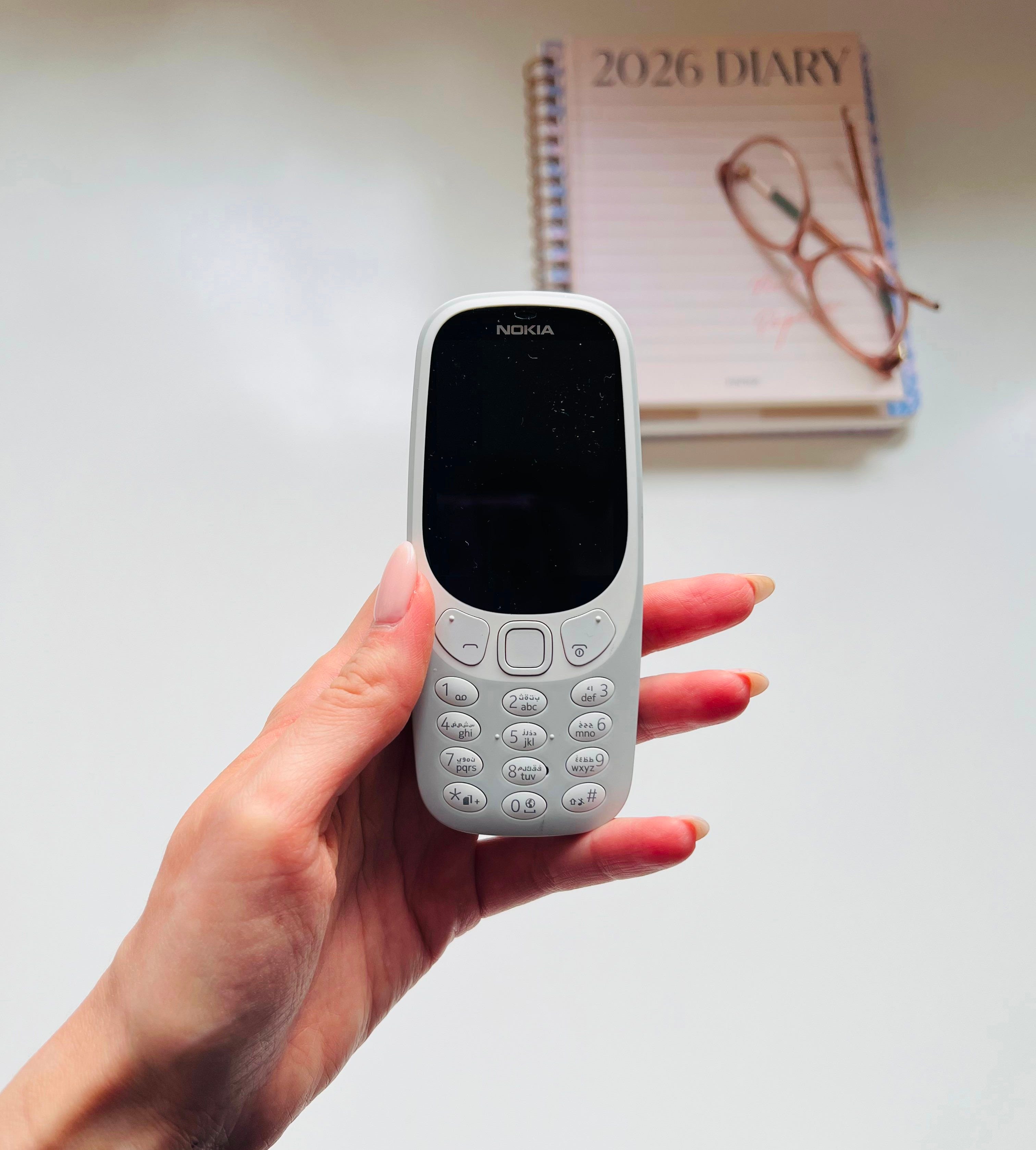
And yet, sometimes I get so tired of being perfectly aware that if I added up all those minutes refreshing my inbox or tapping on my lock screen I could have learned Mandarin or mastered the cello; of Instagram making me feel inadequate in ways I didn’t even know I could feel inadequate about, (like not having the face for talking to my camera at awkward angles, or being able to twerk); so sick of my ADHD brain, that I take out my old Nokia 3310, swear off my smartphone for good and imagine a whole another life…
A life that mirrors the old halcyon days of previous centuries… when people’s full focus and concentration was applied at every task, from apple-picking to dinner-making to reading. When a morning began with a hot-off-the-press newspaper and an espresso, rather than a dehydrated Reddit scroll in bed. When it ended with the cosyness of a book lit faintly by a bedside lamp, rather than a jolt of anxiety or envy induced by the random thoughts and images of strangers shoved abruptly and unpredictably in front of our bloodshot eyes. When smartphones didn’t exist and to communicate, people had to insert a finger in a hole and rotate to dial, or better yet– attach messages to the legs of homing pigeons. When the slow pace of life, the lack of constant entertainment, didn’t make people feel bored or restless, but was used as an opportunity to retreat into themselves, to self-reflect and study. To write letters to younger poets à la Rilke or their meditations comme Aurelius. When people were bold enough to chat up strangers in bars and train stations rather than cravenly slide in their DMs. When they… had to think when faced with a problem, rather than ask ChatGPT. When they had to memorise routes and streets to get around because they weren’t readily available at their fingertips. I would cut 10 inches of my hair to go back to those days.
And as much as I would like to believe that this isn’t just a chimera and that indeed going back is possible, I also have reason to believe that just swearing off our phones might not be the solution to all of our issues.
When I was at university, doing my bachelor’s in Psychology, I worked as a part-time nanny. The eight-year-old boy I looked after was diagnosed with depression and was also addicted to video games. When I made the twenty-minute walk from my house to his, his mother would point to the post-it notes on top of Tupperware boxes and explain what I needed to give him for each meal time. But other than this, once she left, I hardly had any other duties. He would usually spend most of his time in the other room playing video games, while I sat on the sofa in the living room reading C.S. Lewis’s Mere Christianity. (I was in that phase then.) One afternoon, I ventured to ask the mom if her son was addicted to video games, why didn’t they do anything to restrict his playing? Her reply left a strong impression on me. She said it was because his psychiatrist didn’t advise it since the boy was depressed and video games were one of the very few things that made him happy. They helped his brain release more dopamine. She said if he was to cut off all video game playing, his depression would worsen. (They did, however, try to limit it.)
I often think about this in the context of our phone addictions. As described above, I hate my phone (and my primitive self with my phone) with a passion. But I also know that, as pathetic as it is, on some days, those few extra molecules of dopamine that a funny reel gives me, the validation of the hearts on a post, the unexpected replies to a story that lead to a quick exchange, can be life-saving. That they can make the difference between an afternoon spent crying on the bathroom floor and soldiering on. How many times have you received a GIF or a meme and then thought about it and grinned to yourself for days afterwards? How many times did it reduce the unbearable weight of being, dilute the influx of heartbreaking news of yet another Trump-inflicted quagmire, rescue us from self-importance with self-irony, turn the mundane into something more manageable, even if ever so slightly?
When I was in high school, we had these bean bags at the end of the hall where we sat to hang out after lunch or during recess. We had benches and stony steps outside in the school yard. Pairs of friends and cliques would sit along them like birds perched on a wire. Social media is our virtual equivalent of the bean bags long after school. It’s where we go to hang out simultaneously with everyone we know. It’s how we get to show off our new pair of shoes and feel a pang of excitement, of popularity that we previously did when walking down the hallway.
There’s an obvious conundrum – if we all just crave more connection and validation, if we are lonely or depressed and we know that the connection that social media provides is the equivalent of a bag of chips, whereas inviting our childhood buddy over in our living room is home-made chicken soup – why can’t we just do more of the latter? Why can’t we address the reasons underlying our addiction, so we don’t have the craving for our smartphones, or social media, in the first place?
I think we should. Not least because social media can assuage our loneliness at times, but just as often it stands in the way of real connection. How many times have you sat at a dinner table with your family, or on the sofa with your partner, and the reason that you can’t connect is because everyone’s on their phone? How often have you or your partner missed what couples therapists call ‘a bid for connection’ – a verbal or nonverbal attempt to gain a partner’s attention to share a joke, a look, a valuable piece of information because you, or they, were staring at a screen?
So, yes. I do think we should take active steps to address the loneliness epidemic that we live in, by, for example, prioritising time spent with friends and family over a night on the sofa with our phones or laptops (maybe you aren’t feeling lonely, but the person you were going to meet does). We should have solid boundaries with social media to ensure that it’s not harming our actual real-life human connection; that in our quest to take the perfect photo and post it, we have not actually missed seeing the sunset through our own eyes (rather than the camera lens), tasting the banana bread, rather than mindlessly chewing while captioning a story.
But... I don’t think (much to my chagrin) that we could realistically ever go back to those halcyon days that I dream of. Our brain chemistry is too altered. Our lifestyles, lack of communities and sense of belonging fail to provide the necessary environment to know that we wouldn’t sacrifice more than we would gain if we made this change– to avoid a profound sense of deprivation that might not just be emotional, but have real, tangible losses.
Social media allows us to connect not just to each other, but to what’s happening. For many, it’s a primary source of news. I can hear you say, ‘I don’t need some bite-sized news post aimed at pea-brained people to tell me what’s going on, I could just log in to The New York Times and read the actual news, thank you very much.’ Kudos to you! You’re an endangered species. But... Social media allows us to also impact the news. I witnessed this first-hand with the anti-government protests that took place in Bulgaria in early December. They never would have attracted so many people and made it possible to actually bring down the government, if it wasn’t for the huge momentum on social media. Social media allows us all to have a voice and– in an age where the megaphone is most often given to some random alt-right misogynist whose hateful post on X resonates with Musk himself– every voice, big and small, even if it speaks to just a hundred people, matters.
Besides, (and again, I really wish it wasn’t this way) but, whatever your vocation is – modelling, politics, illustration – a big following on social media nowadays paves an easier path to success. If I had a million followers on Instagram, more of you would be reading this newsletter. And as much as I don’t want to make reels, I do want my writing to reach a wider audience.
A few years ago, I took a year-long break off Instagram. The algorithm is still punishing me for it. My posts used to get 200+ likes, now they barely accumulate 40 and sit there in embarrassment, like the kid no one wants to play with at the sandpit. I quit because I was tired of comparing myself to others. Because I hated the insidious ways of the algorithms and the owners of the brains behind them. Because I wanted to make my time mine again.
But I’ve come to realise that the real act of defiance against the bad guys who own social media is not to quit, uninstall, and become a Luddite. Because that just amplifies the toxic voices. It’s holding tightly to our own. The solution to our addled brains and our lonely lives isn’t giving it all up, either.
As ever, it’s finding our place in the balanced middle. It’s playing the game to our own rules and exercising boundaries. It’s forwarding a funny meme, then turning off our phones and sticking our hands in some dirt.
To Reality
With Love,